

The industry is lying to itself. Not maliciously. At least not all of it. But systematically, confidently, and at scale.


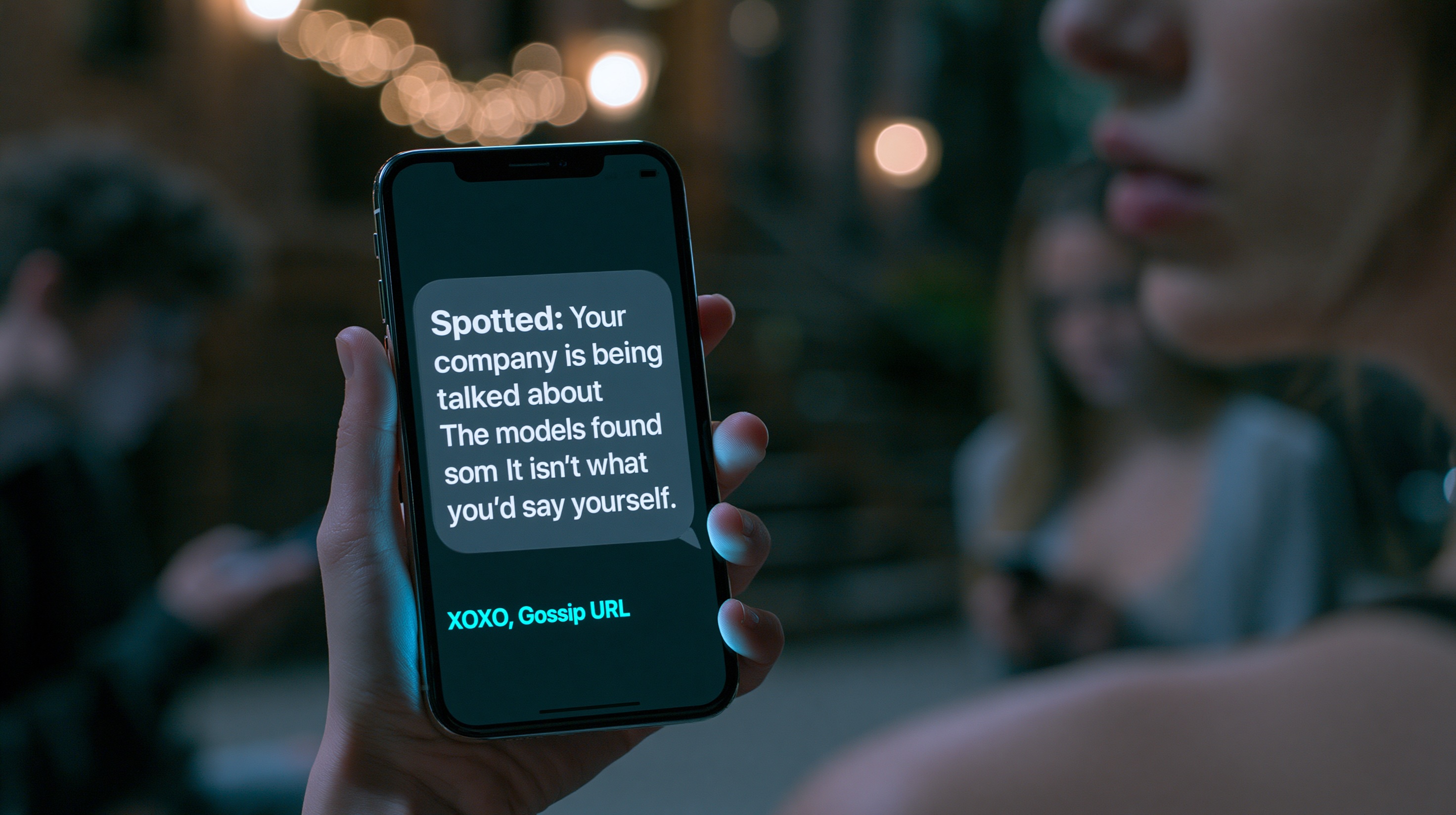
AI talking about your company isn’t a hypothetical. It’s happening right now, thousands of times a day, and it’s accelerating. It isn’t being malicious. It just doesn’t have much to go on, so it’s doing what anyone does with a gap. Filling it with the next best thing it can find.
Right now, someone is asking an AI about your company. Maybe it’s a buyer doing research before a call. Maybe it’s an analyst writing a market map. Maybe it’s a developer asking Cursor or Claude what tool to use for their problem. The question gets answered. You won’t see the conversation. You won’t know what was said. And the answer won’t be yours.
We’ve been writing about this shift for a while. From Product to Promise laid out the framework. The Automation Lie named the problem. This is what comes next.
Think about how gossip actually works. Someone asks about the new hire. Nobody really knows her yet, so somebody repeats what they heard from somebody else. It isn’t cruelty. It’s just that the best available information was thin, and the question still needed an answer.
Your company has that problem right now. A model gets asked about you. It reaches for what it can find. A Reddit thread from 2023. A pay-to-play roundup that listed you alongside four competitors. A Wikipedia article that hasn’t been updated in two years. A blog post someone wrote after a brief demo. That’s what it stitches together. That’s the story it tells.
The question is whether the story it tells is the one you’d tell yourself.
You have a website. You have a blog. You have a README, a pricing page, an about page, a LinkedIn company page. You have all of that. And it matters, because that’s where the agent goes first. But here’s what most companies haven’t reckoned with: the agent doesn’t read your site the way a person does.
It doesn’t follow your navigation. It doesn’t feel your brand. It doesn’t intuit your positioning from the hero section. It crawls. It scrapes. It pulls fragments from across the web, weighs them against each other, and assembles an answer from whatever it can reach fastest. If your site is well-structured and clearly written, you might be part of that answer. If it isn’t, or if the agent can’t find what it needs in a machine-readable form, it moves on. And the gap gets filled by whatever else it found.
Most companies assume that having a website means they’re present in these conversations. They’re half right. They’re reachable. But reachable isn’t the same as understood.
For twenty years, the question was “can they find you?” You optimized for search. You ranked for keywords. You built content for crawlers and pages for funnels. The goal was visibility.
The question has changed. The models aren’t searching. They’re answering. They don’t return a list of links and let the human choose. They synthesize a response and present it as fact. When someone asks “what’s the best tool for X?” the model doesn’t give ten blue links. It gives a name. Maybe two. And it gives reasons.
This means the old playbook doesn’t map cleanly. You can rank #1 for your own brand name and still have an AI tell someone a story about you that you wouldn’t recognize. The game is no longer about being found. It’s about being understood, accurately, by something that reads your company the way a machine reads, not the way a buyer browses.
We call this the narrative layer. It’s the gap between what your company actually is and what the machines say it is. And right now, for most companies, that gap is wide.
We’ve spent the last year building and testing this at Sightbox, and we’ve found that four things have to be true before an AI tells your story the way you’d tell it yourself. Three you put out. One comes back.
Access. Can it find you? This is the floor. If the agent can’t reach your site, or can’t parse what’s there, nothing else matters. You’d be surprised how many companies fail this one. The site looks great in a browser and returns nothing useful to a crawler. Reachable, but there’s nothing built for what arrives.
Record. Is it the same story? Ask the model the same question three different ways. Do you get the same answer? Or does it drift? Inconsistent sources produce inconsistent narratives. If your homepage says one thing, your docs say another, and your press kit says a third, the model picks whichever it found most recently. You’re not telling one story. You’re telling three, and the machine gets to choose.
Story. Is it worth repeating? This is where most companies are weakest, and it’s the hardest one to fix. The model can reach you. The record mostly holds. But when it’s deciding what to say about you, it reaches for the most interesting thing it can find. If your story is less interesting than the rumor it’s replacing, the rumor wins. If your positioning reads the same as four competitors, the model picks one and moves on. Distinctiveness isn’t a feeling. It’s whether a reader could tell you apart with the names removed.
Resonance. What’s coming back? This is the one that listens. Once you’ve put the first three layers out, you measure what the models are actually saying. Not what you hope they’re saying. What they’re saying. Measured monthly, it tells you where the gap is, which layer is drifting, and what to fix next.
Most companies come in expecting a plumbing problem. It’s usually further up than that.
This is what Beacon does. It doesn’t hack the models. It doesn’t game the system. It does what somebody who actually knows would do if they walked into the room: it sets the record straight, in the place the machines go looking, in language they can actually use.
It gives every model the version you’d give a buyer yourself. Then it listens for that version coming back.
The conversation is happening. It’s happening right now. The only question is whether what’s being said is yours or somebody else’s.
Find out what it’s saying. Put in your domain at sightbox.co/beacon. The scan is free. The diagnosis is one sentence. It’ll probably surprise you.

The industry is lying to itself. Not maliciously. At least not all of it. But systematically, confidently, and at scale.

NVIDIA’s NemoClaw and OpenClaw signal a shift from building AI models to operating them at scale—defining the next era of AI infrastructure and execution.

We’ve spent years sitting across the table from founders who just raised their first real round. Series A. Sometimes B. The check cleared. The press release went out. The LinkedIn post got its 200 likes. And then, almost without exception, the same thing happens. The founder looks around the room — at the team, at …

The OpenAI–Pentagon deal isn’t a strategy failure. It’s a textbook case of what happens when a brand ignores its own Promise Market Fit.